UP Chief Minister Yogi Adityanath: terms and role
His two terms, how a Chief Minister is appointed and where to find project records or official help.
Prime Minister's Office GODL-India Read the guideUseful guides
Two Houses, different elections. A simple guide to the names, seat counts and headlines that are easy to mix up.
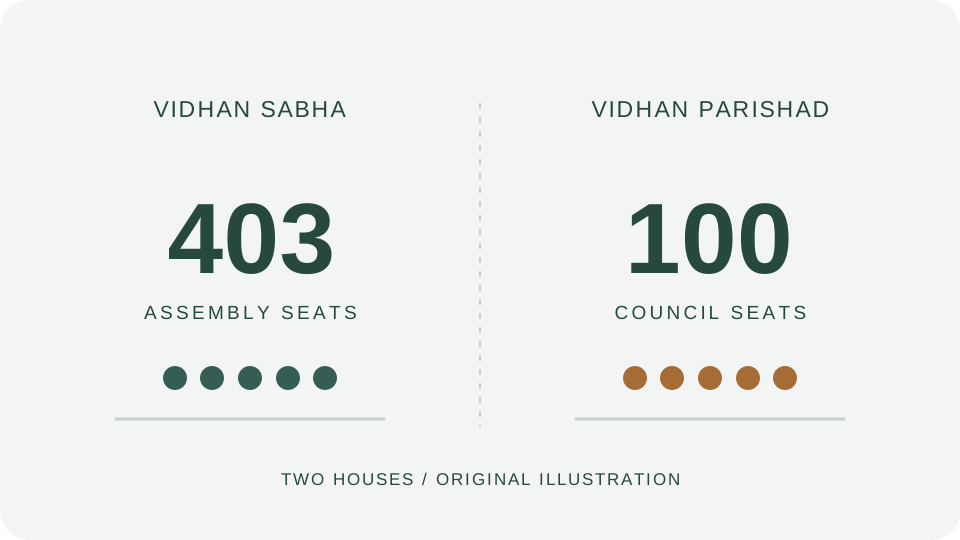
No. The Vidhan Sabha is the Legislative Assembly; its members are MLAs. The Vidhan Parishad is the Legislative Council; its members are MLCs. A result for one House is not automatically a result for the other. UP's Assembly has 403 seats in the cited ECI table, while the official Council composition document lists 100 seats. These are full-strength seat counts, not a statement that every seat is occupied today. S19 S24
| Question | Vidhan Sabha / Assembly | Vidhan Parishad / Council |
|---|---|---|
| Members are called | MLAs | MLCs |
| Listed seat count | 403 | 100 |
| How members are chosen | Direct constituency elections | Different electorates and nominated seats |
| Does one general-election result replace the whole House? | The Assembly has a normal five-year term unless dissolved sooner | The Council continues; roughly one-third retire every two years |
The direct-election distinction comes from Article 170; the term distinction comes from Article 172. Their linked text is from an independent constitutional reference site, not a new election notice. S26 S27
Assembly members are chosen by direct election from territorial constituencies. That is different from assuming that every person on an ordinary Assembly electoral roll also votes in every MLC election. S26
The Council's official composition document lists these allocations: S24
This is a way to understand the categories, not an eligibility check for any reader. Use the specific official notice and electoral roll for the election concerned. We do not collect qualifications, voter IDs or political preferences. The Council figures were read from its official document's indexed text; we did not inspect a current member roll or count live vacancies.
Article 172 describes a continuing Council: it is not dissolved as a whole, and approximately one-third of its members retire every second year. The Assembly's ordinary term is five years from its first meeting unless dissolved earlier; the article also contains an emergency-extension exception. These different rules explain why the two Houses need not share one election cycle. S27
They do not give us a 2027 polling day. For the source-limited current Assembly term and where to check an announced schedule, use the UP election 2027 date guide.
With a full-strength 403-seat Assembly, 202 is simply more than half of 403. That is arithmetic based on the cited seat count, not a poll, prediction or a claim that a party currently has 202 seats. Vacancies and the rules applying to a particular vote can matter; this guide is not a ruling on a confidence motion. S19
Do not substitute the Council's 100 seats, a survey's projected seats or a social-media graphic for an officially declared Assembly result.
Article 164 says the Governor appoints the Chief Minister and the Council of Ministers is collectively responsible to the Assembly. That is not a direct statewide ballot for the Chief Minister's office. Read the Chief Minister role and terms guide for the institutional explanation and historical oath dates. S25
This page explains institutions; it does not announce candidates, live results, registration deadlines or a prediction for 2027.
Last reviewed:
Useful guides
His two terms, how a Chief Minister is appointed and where to find project records or official help.
Prime Minister's Office GODL-India Read the guideWhat we can verify about the Uttar Pradesh Assembly, where to check election dates and what not to mistake for an official result.
Yogi2027 CC0 1.0 Read the guideWhere to find government help, how Jansunwai works and why a public helpline is not a personal mobile number.
Yogi2027 CC0 1.0 Read the guide